

Replacing Halogen Bulbs with LEDs
Menachem Briskman asks “Why are we changing our lightbulbs?”
Light bulb technology improved dramatically in recent years, and the latest ones not only save energy to reduce emission, but also pay for themselves in electricity savings.
Traditional light bulbs work by heating a wire to a high temperature so that it glows. Unfortunately, most of the electrical power used is converted to heat rather than light, so these bulbs are fairly inefficient. More recently halogen filled bulbs replaced the earlier vacuum ones. These still relied on heating a coil, but by filling the bulb with halogen gas, it was possible to heat the coil to a higher temperature without oxidising it, and improve efficiency.
The latest bulbs use Light Emitting Diodes, or LED, and they convert electricity directly into light.
Early LED bulbs were criticised for harsh lighting, but this is no longer the case.
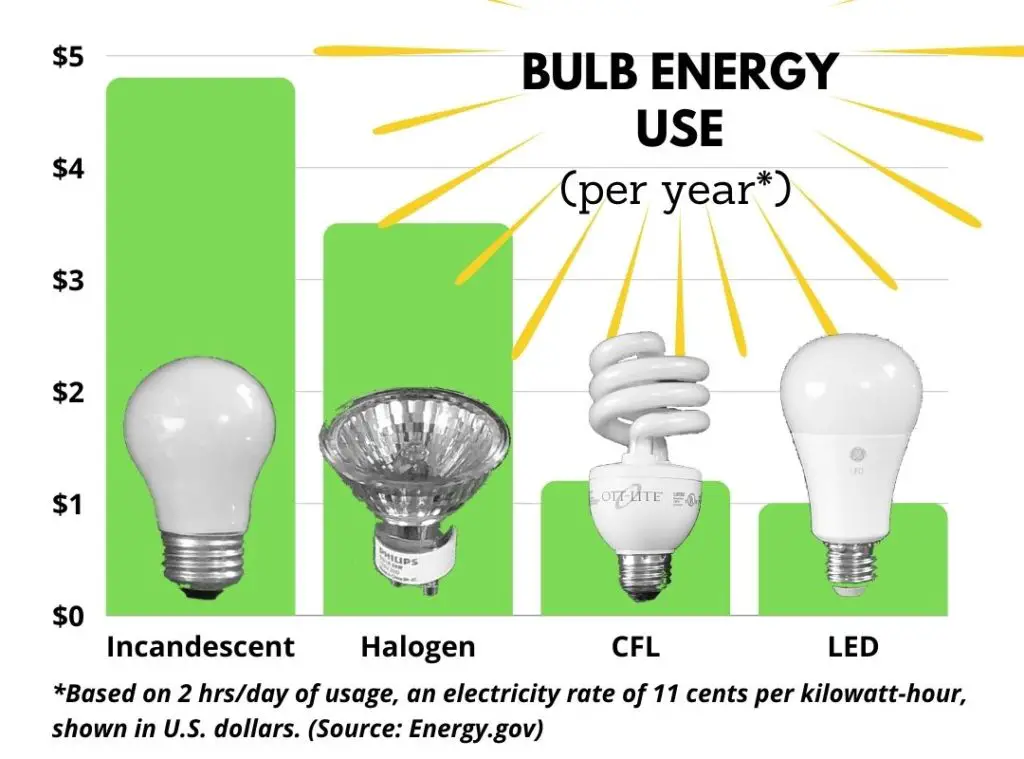
If you still have traditional bulbs, then replacing them with LED even before they fail makes sense. In addition to reducing CO2 emission, they pay for themselves in a short time. The table below illustrates the savings that are made by changing from Halogen to LED bulbs. They are based on 1000 hours of use – equivalent to a year at 3 hours per day, or 6 months at 6 hours/day.
LED bulbs also last a long time, with 15,000 – 50,000 hours claimed compared with 2000 for halogen, so there is also a considerable saving in bulb replacement costs
What should you consider when replacing your light bulbs?
If we are satisfied with the present level of lighting, then we need to ensure that the replacement bulbs provide the same amount of light. The lighting power of a bulb is measured in lumens, so you need to replace the bulb by an LED unit producing about the same lumens. Some manufacturers refer to “equivalent Watts”, but this is confusing, because it relates to the wattage of older, non-halogen lamps, which have been out of circulation for some time.
Dimmer switches
If dimmer switches are installed, it is essential to purchase LED bulbs that are stated to be dimmable. Even then, some older dimmers do not work well with dimmable LEDs, and you may be forced to change the dimmer. You may choose to replace the bulbs controlled by one of the dimmers first, and observe the result. Typical problems are flickering at some settings, and non-linear control.
Low voltage bulbs
Most light bulbs use standard mains voltage (230 V), but some are designed for much lower voltages, in conjunction with a transformer. When replacing these bulbs by LED, you would need to ensure that the same voltage is used, and that they can be fitted as a direct replacement, without additional/replacement components.
Colour of the light
Traditional bulbs produce a reddish light, unlike the daylight that is much whiter. LED bulbs are available in a range of colours, expressed in 0K. 2700 – 3000 0K is equivalent to traditional bulbs. 5000 – 6000 0K represent daylight.
Fluorescent tubes
Complete strip light fittings are available in LED, and it is now also possible to buy replacement LED to fit into an existing fluorescent unit. Fluorescent lighting is much more efficient than halogen, so the energy gain in replacing them by LED is not large. It does make sense however to choose LED when replacing blown tubes or obsolete fittings.
Detailed information
There are plenty of lighting vendors, but you may find the TLC Electrical web site useful for detailed information or specifications for light bulbs. It’s also worth having a look at this more in-depth fact sheet provided by the Nottingham Energy Partnership